
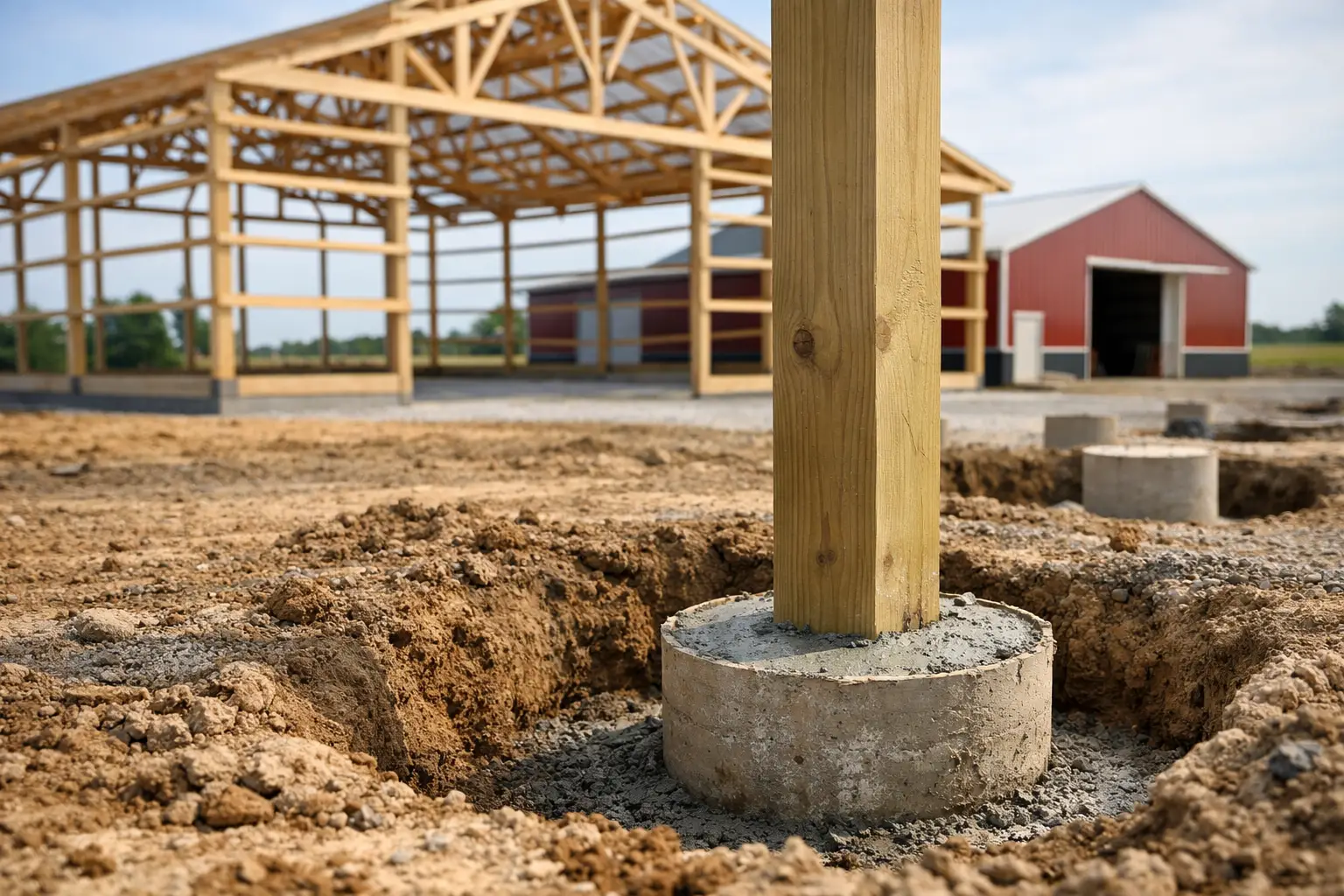
If you’re pricing a barn, shop, garage, or equipment shed, one of the first questions is simple: do post frame buildings need foundations? The short answer is yes, but not always in the way people mean when they picture a traditional continuous concrete footing and stem wall. Post-frame construction still needs a sound foundation system. It just uses a different load path than a conventional stick-built structure.
That distinction matters because a lot of confusion starts with the word foundation. Some buyers assume a post-frame building skips the foundation entirely. Others assume it needs the exact same concrete perimeter as any other building. In reality, the right answer depends on the building use, soil conditions, engineering requirements, local code, and whether the structure will have an enclosed slab, a living space, or heavy point loads inside.
What counts as a foundation in post-frame construction?
In a post-frame building, the structural posts typically carry roof and wall loads directly into the ground or into engineered concrete elements. That means the foundation may be a system of embedded columns, concrete collars, piers, brackets on piers or walls, or a perimeter foundation paired with post anchors. It is still a foundation. It just is not always a full continuous footing under every exterior wall.
This is one reason post-frame buildings are efficient. By concentrating loads at column locations instead of distributing them through closely spaced studs on a continuous wall footing, the building can often reduce excavation, forming, and concrete work. For many agricultural, storage, workshop, and suburban outbuilding applications, that is a major advantage.
Still, less concrete does not mean less engineering. A post-frame foundation has to resist vertical loads, uplift, lateral movement, frost effects, and long-term settlement. Done right, it performs extremely well. Done poorly, it creates problems that are expensive to correct later.
Do post frame buildings need foundations if posts go in the ground?
Yes. Embedded posts are one of the most common post-frame foundation systems, especially for barns, shops, equipment storage, garages, and similar structures. The post itself becomes part of the engineered foundation system.
In that setup, each column is set at a specified depth based on frost depth, soil bearing capacity, wind exposure, and structural loads. Concrete is often used around or below the post as part of the footing and uplift resistance design. The details vary by engineer and site conditions, but the point is the same: the building is not sitting directly on loose soil and hoping for the best. It is relying on a planned, load-bearing foundation system.
For many owners, this is the practical answer because it balances strength, speed, and cost. It can also simplify construction compared to digging and pouring a full perimeter footing before the building frame goes up.
When a full concrete foundation makes sense
There are cases where a traditional concrete foundation is the better fit, or may be required.
If the building is a barndominium or another occupied structure, a continuous perimeter foundation may be part of the design. The same is true when local code, engineering, or the building layout calls for it. Some buyers also prefer a wall or pier-and-bracket system because they do not want wood members embedded below grade.
A full concrete perimeter can also make sense on sites with challenging drainage, highly variable soils, or design conditions that benefit from a different foundation approach. Commercial buildings, buildings with special fire separation requirements, and structures with interior load-bearing features may also call for more substantial concrete work.
That does not mean post-frame stops being post-frame. It simply means the framing system is paired with the foundation type that best matches the project.
The slab is not always the foundation
Another common misunderstanding is assuming the concrete floor slab is the foundation. In many post-frame buildings, it is not.
A slab-on-grade may be poured after the shell is up, and its main job may be to provide a durable finished floor. The structural support for the building often comes from the posts and their engineered footings or piers, not from the slab itself. That matters when you’re budgeting and planning sequence. The building may be designed so the slab is optional, delayed, or sized for a specific use such as vehicles, livestock traffic, storage racks, or shop equipment.
If you need thickened slab edges, insulation, vapor barriers, radiant heat, drains, or heavier concrete for point loads, those should be discussed early. A building used for hay storage has different slab needs than a mechanic’s shop or airplane hangar.
Soil, frost, and drainage change the answer
The question do post frame buildings need foundations cannot be answered well without talking about the site. Soil and water conditions have a direct impact on foundation design.
In Oregon and Washington, conditions can vary a lot from one property to the next. Some sites have well-draining native soils. Others have wetter ground, fill material, slope issues, or seasonal movement. Frost depth also matters, especially in colder areas and higher elevations.
If the soil has lower bearing capacity, the footing size or design may need to change. If drainage is poor, the site may need grading, compaction work, downspout planning, and base prep to protect long-term performance. Water is one of the biggest factors in foundation trouble, whether the building is post-frame or conventional.
That is why experienced builders ask detailed questions up front. The intended use, dimensions, door locations, site access, and ground conditions all affect what the foundation should be, not just what the building looks like on paper.
Permanent wood columns vs bracket-mounted posts
Some customers are comfortable with pressure-treated columns embedded in the ground. Others want all wood held above grade on brackets attached to concrete piers or walls.
Both approaches can work when properly designed and installed. Embedded columns are common because they are efficient and structurally effective. Bracket-mounted systems can be attractive when a buyer wants a certain foundation style, expects more finished interior conditions, or simply prefers that approach.
The trade-off usually comes down to cost, site conditions, engineering, and building use. A bracket and pier system often adds concrete and hardware cost. Embedded posts may streamline construction and reduce concrete work. The right choice is the one that fits the project rather than the one that sounds more familiar.
Code and engineering matter more than rules of thumb
A lot of online advice treats post-frame foundations like a one-size-fits-all detail. That is risky.
Foundation requirements should be driven by engineered loads and local code, not by generic assumptions from a video or a neighbor’s shed. Wind exposure, snow load, seismic factors, occupancy type, and building size all change the structural demand. A small open-sided loafing shed is not held to the same standard as a fully enclosed commercial building or a finished residential shell.
That is also why pricing can vary between two buildings that seem similar at first glance. The foundation system may be different because the use is different. A riding arena, insulated shop, equipment building, and barndominium all ask different things from the structure below them.
How to tell what your building actually needs
If you’re in the planning stage, the best move is to define the project clearly before focusing on foundation type alone. Start with use. Is this for livestock, equipment, vehicles, storage, workspace, retail, or living space? Then consider dimensions, bay spacing, wall height, door openings, interior slab needs, insulation, and whether you want a kit or full construction.
From there, site information becomes critical. Soil conditions, slope, drainage, and jurisdiction all help determine whether embedded posts, piers, brackets, or a perimeter wall make the most sense. A good quote process should account for those details early so you are not comparing incomplete numbers.
This is where working with a specialist helps. A company focused on post-frame buildings can usually spot foundation issues before they become change orders. That is especially valuable when your project has large overhead doors, tall sidewalls, finished interiors, or mixed-use needs.
The real answer
So, do post frame buildings need foundations? Absolutely. They need the right foundation system for the building, the site, and the way you plan to use it. Sometimes that means embedded posts engineered as part of the foundation. Sometimes it means piers, brackets, or a full concrete perimeter. The mistake is assuming there is only one correct version.
The better question is not whether your post-frame building needs a foundation. It is which foundation system gives you the best long-term performance for your specific project. Get that part right, and the rest of the building has a much better place to start.