
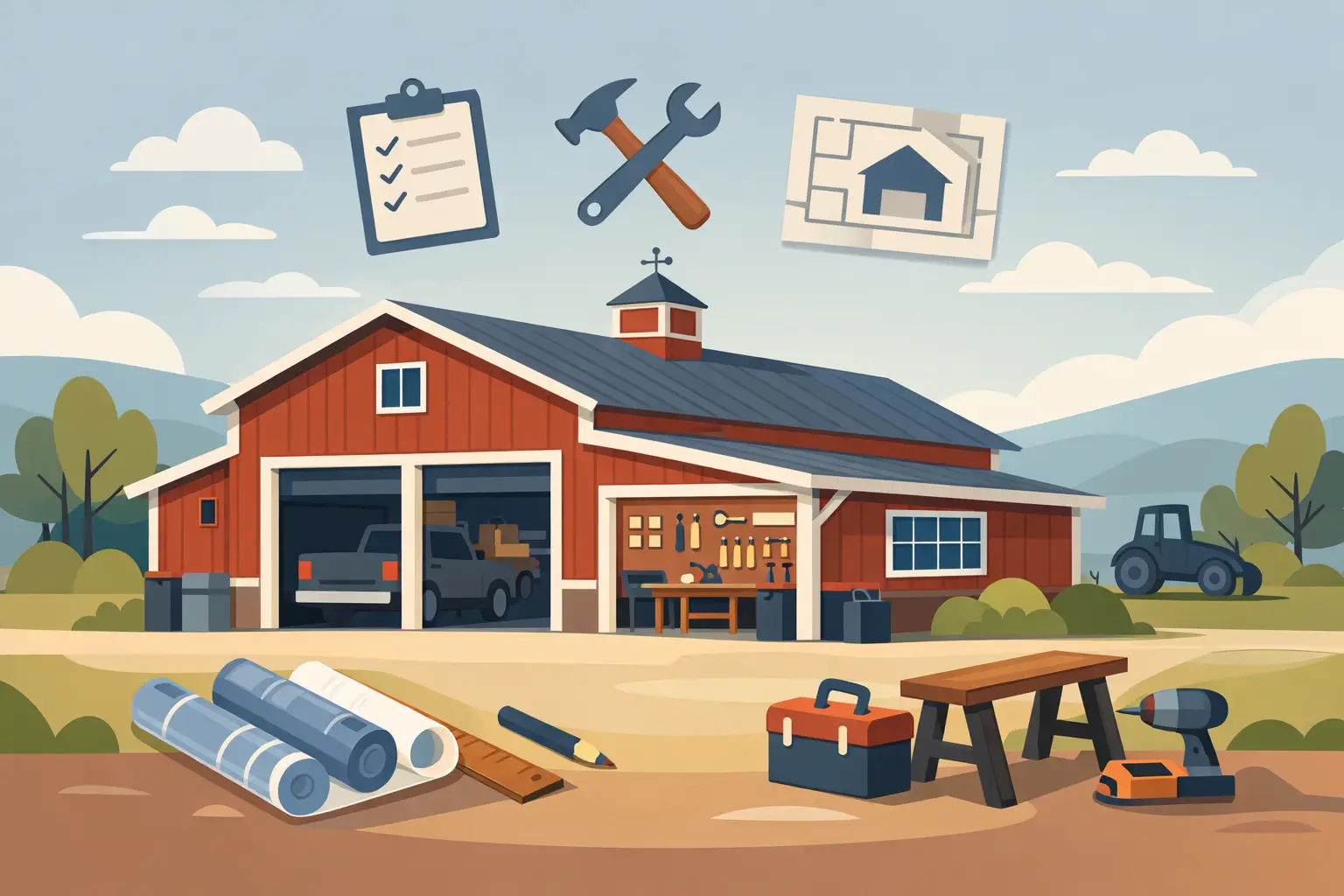
A pole barn garage with workshop usually sounds simple at first – park vehicles on one side, set up tools on the other, and get to work. In practice, the buildings that work best are the ones planned around traffic flow, power needs, storage, and how the space will actually be used in January, not just on a sunny Saturday in July.
That matters because this type of building often ends up doing more than one job. It may need to hold trucks, tractors, trailers, welding equipment, lawn equipment, compressed air, parts storage, and a workbench that stays usable year-round. If the layout is off, the building can feel crowded long before it is technically full.
What makes a pole barn garage with workshop a good fit
Post-frame construction is a strong option when you need open interior space and flexibility. Because the structural system reduces the need for interior load-bearing walls, it gives you more freedom to set the building up around vehicles, tool stations, mezzanine storage, or a dedicated enclosed shop room.
For many property owners in Oregon and Washington, that flexibility is the main advantage. A garage-only building can be fairly straightforward. A garage plus workshop takes more planning because parking space and work space compete with each other. Post-frame design gives you room to solve that without forcing a complicated footprint.
The other advantage is customization. Door sizes, wall height, roof style, overhangs, windows, insulation packages, and interior partitions all affect how the building performs. A workshop that handles woodworking has different needs than one built for equipment maintenance or fabrication. The building should reflect that from the start.
Start with the use case, not just the size
A common mistake is choosing dimensions before deciding what needs to happen inside. A 30×40 may be plenty for one owner and too tight for another. It depends on what you are parking, what you are repairing, and whether the workshop needs to stay clear while vehicles are inside.
If the building is mainly for pickups and general storage, the workshop area may be a bench wall with cabinets and floor space for occasional projects. If the goal is serious year-round shop work, it may make more sense to separate the garage bay area from the work area with a wider footprint, an interior partition, or even different door placements.
Think in terms of real movements. Can you open truck doors fully? Can you back in a trailer without blocking the bench area? Is there enough clearance to move sheet goods, lumber, or equipment through the building without constant rearranging? Those questions often shape the right layout faster than square footage alone.
Layout decisions that matter most
The best workshop garages usually have clear zones. Parking, active work, tool storage, and material storage each need their own place. When those zones overlap too much, the building starts to fight you.
Vehicle bays and work area spacing
A two-bay layout with a workshop along one side is common, but it works best when the width allows comfortable separation. If your vehicles take up most of the center floor, the workshop becomes wall storage instead of true work space. In that case, going wider is often a better investment than going longer.
Depth matters too. A shallow building may fit vehicles but leave little room around them. Extra depth gives you room for benches, shelving, compressors, or a rear work zone without forcing every project into the driveway.
Door placement
Overhead doors are not just about getting vehicles in and out. Their size and placement affect wall space, lighting, storage options, and how much usable workshop area remains. Large doors are useful, but too many large openings can eat up the best walls for cabinets, racks, and benches.
A separate entry door for the shop side is often worth including. It lets you access the workspace without opening a large overhead door, which helps with security, energy efficiency, and daily convenience.
Ceiling height and overhead space
Wall height should match current equipment and likely future use. If you may own a taller RV, tractor, lift, or enclosed trailer later, plan for that now. It is far easier to build for height on the front end than to wish you had it later.
Higher walls can also improve workshop function by creating room for better lighting, loft storage, or larger shelving systems. The trade-off is cost, and not every project needs extra height. The right answer depends on what will actually live in the building.
Don’t treat the slab as an afterthought
For a true workshop, the concrete slab is part of the working system. Thickness, reinforcement, finish, drainage planning, and any thickened areas should match the equipment and use. A garage for light vehicles has different demands than a shop that may handle heavier machinery, jacks, welders, or stationary equipment.
Floor drains, wash-down needs, and moisture control should be considered early. So should anchor points if you plan to install a vehicle lift or heavy equipment. These details are much easier to address before the slab is poured than after the building is finished.
If part of the building will stay unfinished or unheated, that can also influence slab planning. A mixed-use building may need different floor performance in different zones.
Insulation, ventilation, and power are where comfort is won or lost
A workshop that only works well in mild weather is not much of a workshop. If you plan to spend real time in the building, insulation and ventilation deserve as much attention as doors and dimensions.
Insulation strategy
What you choose depends on whether the entire building will be conditioned or only the shop area. Some owners heat the whole structure. Others isolate the workshop and leave garage bays unconditioned. Either approach can work, but the design should support it.
Insulation at the roof and walls, along with thoughtful air sealing, helps protect tools, improve comfort, and reduce heating costs. If you are storing moisture-sensitive items, it also helps with condensation control.
Ventilation and indoor air quality
If the workshop will involve painting, welding, engine work, or wood dust, ventilation is not optional. Natural airflow through doors and windows helps, but many shops need a more deliberate plan. Exhaust, fresh air intake, and fan placement can make the difference between a shop that is pleasant to use and one that is not.
Electrical planning
Underpowered shops are frustrating from day one. Plan circuits around real tools and equipment, not a rough guess. Lighting, air compressors, welders, dust collection, battery charging, heaters, and future equipment all add up fast.
Good lighting is part of that discussion. Overhead fixtures should support both parking and bench work. Many owners also benefit from task lighting at benches, worktables, and tool stations.
Storage is usually the difference between useful and cluttered
Most garage-workshop buildings need more storage than the owner expects. Seasonal equipment, parts bins, fasteners, fluids, ladders, and long materials can overwhelm the floor if they are not planned into the design.
Wall space, overhead storage, shelving depth, and dedicated utility zones should be considered early. If you know you need a compressor, air lines, dust collection, or a mechanical corner, give it a home on the plans. Otherwise, those systems end up taking over prime work space.
This is also where window placement matters. Windows bring in natural light, but too many can reduce usable wall area for cabinets and racks. There is always a balance between brightness and storage capacity.
Think through the build path before you finalize the design
Not every buyer wants the same level of involvement. Some want a turnkey contractor. Others want a building kit and plan to handle all or part of the work themselves. The right path depends on your schedule, budget, experience, and local subcontractor availability.
That choice can affect the design itself. A more customized workshop with detailed interior requirements may benefit from a more guided design-and-build process. A simpler shell built from a kit may be the right fit if you plan to finish the inside over time.
If you are comparing options, it helps to gather the practical details first: target dimensions, intended use, roof style, preferred door layout, window count, insulation goals, and whether you want the building supplied only or fully constructed. That is the kind of information that leads to a more accurate quote and fewer revisions later. Locke Buildings works with both full-build customers and kit buyers, which gives property owners room to match the project to their budget and build plan.
A better project starts with fewer assumptions
The strongest pole barn garage with workshop is not always the biggest one. It is the one designed around how you park, how you work, what you need to store, and how you want the building to perform five or ten years from now.
If you treat the workshop as leftover space, the building will feel compromised from the start. If you plan it like a real working environment, it can become one of the most useful structures on your property.