If you are weighing a pole barn vs metal building, the right answer usually comes down to what you need the structure to do, how fast you want to build, and what kind of site you are working with. Buyers often start by asking which option is cheaper, but that is only one part of the decision. Layout flexibility, foundation requirements, insulation plans, future expansion, and intended use matter just as much.
For many property owners in Oregon and Washington, this choice is not really about which system is universally better. It is about which one fits the job better. A hay barn, equipment shed, shop, riding arena, commercial warehouse, or barndominium can all have very different priorities. The smartest way to compare these building types is to look at how they perform in the real world.
Pole Barn vs Metal Building: What is the Difference?
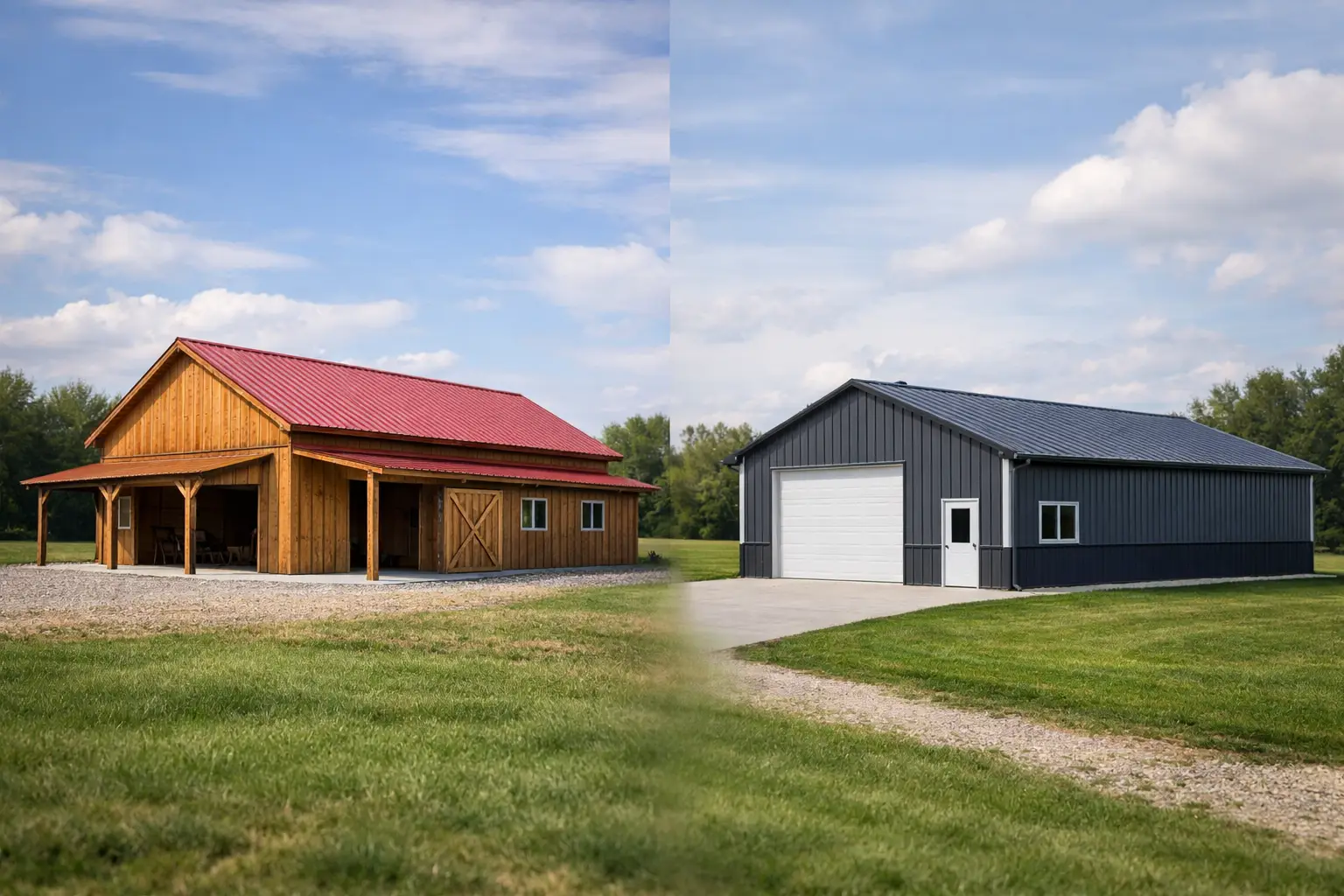
A pole barn is a post-frame building. It uses large wood posts or laminated columns set in the ground or anchored to piers, with framing members that support the roof and walls. The system transfers loads through the posts rather than relying on continuous load-bearing walls. That approach is one reason post-frame buildings can be efficient and adaptable across agricultural, residential, and light commercial uses.
A metal building usually refers to a steel-framed structure, often made from rigid steel frames with metal wall and roof panels. These are commonly used for industrial, commercial, and large clear-span applications. The primary frame is steel, and the structure typically sits on a concrete foundation engineered to support the loads.
Both building types can use metal siding and roofing, which is where some of the confusion comes from. A pole barn is not defined by the exterior panels. It is defined by the structural system.
Cost Depends on More Than the Shell
When buyers compare pole barn vs metal building, cost is usually the first filter. In many cases, a post-frame building has a lower upfront cost, especially for agricultural buildings, storage structures, garages, and workshops. One reason is that post-frame construction often requires less complex foundation work. Instead of a full perimeter foundation designed for a steel frame, many post-frame projects use embedded posts or simpler pier systems paired with a slab or gravel floor, depending on the use.
That said, price comparisons get messy when people compare unfinished shells instead of finished buildings. A lower shell price does not tell you much if one quote includes insulation, doors, windows, overhangs, liner panels, and site-specific engineering while the other does not. The better question is this: what will the completed building cost based on your actual use?
If you need a simple equipment cover or hay building, post-frame often pencils out well. If you need a large commercial structure with wide clear spans, heavy use, and a more industrial spec, a steel building may justify the extra cost.
Foundation and Site Conditions
Site conditions have a big effect on the best building type. Post-frame buildings are often attractive on rural properties because they can work well on a range of sites and may reduce concrete requirements. That can help control costs and shorten the path to construction.
Metal buildings usually need a more substantial concrete foundation system. That is not necessarily a drawback if your project already calls for a slab-heavy, engineered commercial setup. But if your goal is practical enclosed storage, livestock shelter, or a workshop on acreage, extra foundation cost can change the math quickly.
This is also where local knowledge matters. Soil conditions, drainage, wind exposure, and snow load all need to be considered before you lock in a structural system. What works on one property may not be the best answer on another.
Interior Space and Clear Span Needs
One of the strongest arguments for steel is clear-span capability. If you need very wide open interior space with minimal or no interior columns, a metal building can be a strong option. That matters for certain commercial applications, manufacturing, equipment service, and specialized storage.
Post-frame buildings can also deliver impressive open space and are commonly used for riding arenas, shops, machine storage, and agricultural buildings. But there are practical limits based on span, loads, and building design. If your project needs a very specific interior clearance or a high-capacity structural frame, steel may be the cleaner solution.
For many everyday uses, though, post-frame offers plenty of flexibility. A farm shop, garage, animal barn, or storage building usually does not need the same structural profile as a heavy commercial warehouse.
Insulation, Condensation, and Year-Round Use
If the building will be conditioned or partially finished, insulation planning matters early. This is especially true for workshops, garages, commercial spaces, and barndominium-style projects.
Both building types can be insulated well, but the wall and roof assemblies are different. Post-frame buildings give you practical options for cavity insulation, finished interiors, and deeper wall systems depending on the design. That can be an advantage when comfort and interior finish are priorities.
Metal buildings can also be insulated effectively, but buyers need to pay close attention to thermal bridging and condensation control. A steel shell alone is not the full story. The insulation package, vapor control strategy, and ventilation plan are what determine whether the building performs well over time.
If you are planning to heat and cool the space, store moisture-sensitive materials, or create finished living or office areas, those details should be part of the quote from the start.
Customization and Future Use
A lot of buyers start with one use in mind and change course later. A storage building becomes a shop. A farm structure needs an enclosed bay. A garage gets a lean-to or extra overhead door. That is why flexibility matters.
Post-frame buildings are often a strong fit for customized layouts. Door placement, window packages, overhangs, covered areas, interior partitions, and future expansion can often be worked into the design in a straightforward way. That makes post-frame appealing for buyers who want a building tailored to their property and workflow rather than a one-size-fits-all shell.
Steel buildings can also be customized, of course, but the process may be more rigid depending on the system and supplier. For some buyers, that is perfectly fine. For others, especially on rural properties where access, equipment movement, animal flow, and storage patterns matter, post-frame design flexibility is a real advantage.
Best Uses for Each Option
For agricultural buildings, equipment storage, livestock shelters, workshops, garages, and many residential outbuildings, post-frame is often the practical choice. It is efficient, versatile, and well suited to the kinds of custom dimensions and openings many property owners need.
For large-scale commercial and industrial uses, especially where very wide clear spans or heavier steel-frame specifications are required, metal buildings can make more sense.
There is also a middle ground. Some buyers assume a steel building is automatically stronger or longer-lasting, but that is too simplistic. A properly designed post-frame building engineered for local conditions can be extremely durable and high performing. What matters is matching the structural system to the use, site, and budget.
What Buyers Get Wrong in the Comparison
The biggest mistake is comparing generic building types instead of actual project scopes. A fair comparison should include building size, height, doors, windows, roof style, insulation, site prep, foundation approach, and who is responsible for construction. A kit price is not the same as a turnkey build price. A shell quote is not the same as a finished quote.
Another common mistake is focusing only on initial cost while ignoring long-term functionality. If a cheaper building creates layout problems, limits access, or makes future upgrades harder, it may not be the better value.
This is why a consultative quote process matters. A good supplier or contractor should ask how you plan to use the building, what equipment needs to move through it, whether you want it insulated, and whether you are hiring a builder or taking on a kit project yourself. At Locke Buildings, that practical scoping process is a big part of helping buyers avoid expensive missteps.
How to Choose the Right Building for Your Property
Start with the use case, not the material preference. Think about what will happen inside the building on a normal day. Will you park trucks or tractors in it? Need horse stalls or arena clearance? Want a finished shop with heat? Expect to add enclosed space later? Those answers usually point you toward the right structural system faster than broad claims ever will.
Then look at the site, the budget, and the construction path. Some buyers want a full-service builder. Others want a kit they can erect with their own crew or contractor. The right answer should work not just on paper, but in the way the project will actually get built.
If you are choosing between a pole barn and a metal building, do not ask which one wins in general. Ask which one fits your land, your use, and your next ten years better.