
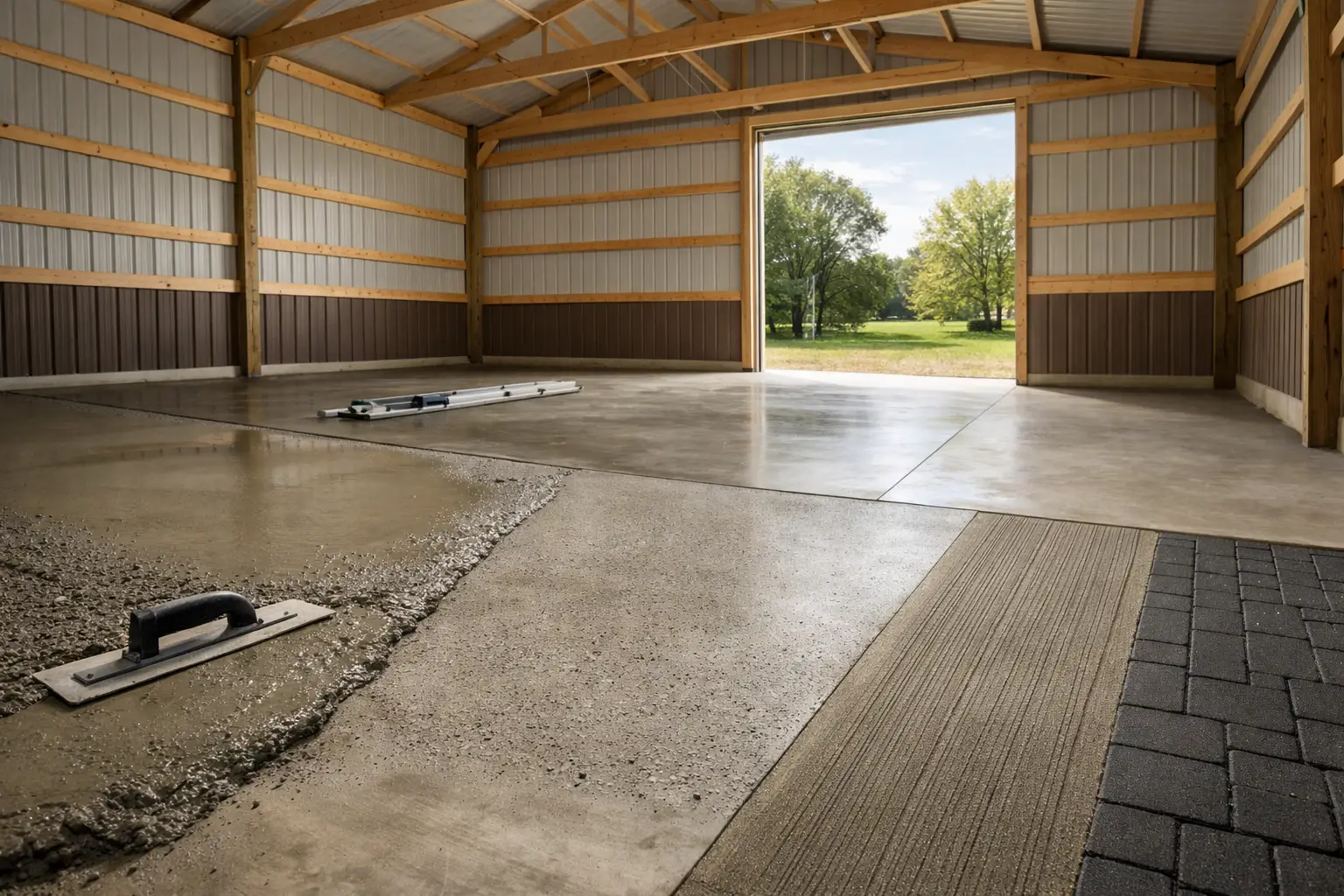
Most pole barn concrete options look simple until you have to live with the result. A floor that works fine in a hay barn can be the wrong choice for a shop, a horse setup, or a barndominium shell. The right answer depends on how the building will be used, what needs to roll in and out, how you want water managed, and whether you are pouring now or later.
That is where a lot of projects get off track. People ask, “Do I need a slab?” when the better question is, “What does this building need the floor to do?” Once you answer that, the concrete plan gets much clearer.
The main pole barn concrete options
For most post-frame buildings, the realistic choices are a full concrete slab, concrete footings with no full slab, a partial slab, or no concrete floor at all beyond site prep and gravel. Each one can be the right choice in the right setting.
A full slab is common for garages, workshops, commercial spaces, and many storage buildings. It gives you a hard, cleanable surface and supports vehicle traffic, equipment, shelving, and finished interior spaces. If you plan to heat the building, work on machinery, or convert part of it to conditioned use later, a slab usually makes sense.
Concrete footings without a full slab are often used where the structure needs specific bearing support but the interior floor does not need to be finished right away. This can make sense for agricultural storage, equipment cover, or phased projects where the shell goes up first and the floor comes later.
A partial slab is a good middle ground. You might pour concrete in a shop bay, wash area, tack room, feed room, or along a drive lane, while leaving other areas gravel. That approach can control cost without forcing the whole building into one use pattern.
Gravel-only floors still have a place, especially in hay storage, livestock shelter, and equipment buildings where drainage, lower upfront cost, and easy maintenance matter more than a hard surface. In some animal applications, gravel or compacted base is actually more practical than concrete.
How building use should drive the decision
If the building is for vehicle storage, a workshop, or a garage, concrete is usually the best long-term choice. It handles jacks, toolboxes, welders, tractors, pickups, trailers, and daily foot traffic better than gravel. It also makes the building easier to clean and brighter inside because it reflects light.
If the building is for livestock, the answer changes. Concrete can be useful in feed alleys, grooming areas, wash racks, and storage rooms, but it is not always ideal in every animal zone. Horses, cattle, and other livestock often do better with footing systems that have more give and better drainage. In those buildings, full concrete can actually create more management work unless mats, bedding, and drainage details are planned carefully.
For hay and commodity storage, many owners skip a full slab unless they need forklift traffic, pallets, or moisture-sensitive storage conditions. Well-prepared gravel may be enough. The same goes for open-sided farm structures and machine sheds where the priority is shelter, not a finished floor.
Commercial and mixed-use buildings usually lean toward a slab because the building may need to support offices, retail areas, workstations, inventory, or future tenant improvements. If there is any chance the building use will evolve, concrete provides more flexibility.
Full slab: where it works best
A full slab is the most finished option, but it also demands the most planning. Thickness, reinforcement, vapor barrier needs, insulation, control joints, door elevations, and drainage all matter. If those details are not worked out early, the slab can limit how well the building functions later.
For a basic storage building, a standard slab may be enough. For heavier shops or equipment use, the slab design often needs to account for point loads, larger vehicles, lifts, or concentrated traffic. Not every concrete floor should be poured the same way just because the buildings look similar from the outside.
This is also where future use matters. A slab for a cold storage building is one thing. A slab for a heated workshop or a finished barndominium area is another. If plumbing, radiant heat, floor drains, or thicker edge conditions may be needed, it is better to think through those items before the pour instead of trying to retrofit around them later.
Pole barn concrete options for phased projects
A lot of owners do not need everything finished on day one. They want the shell built now and the floor added later as budget and use become clearer. That can be a smart approach, but only if the structure and site are planned for it.
If you may add a slab later, the building layout, grade, door thresholds, and base preparation should support that future pour. Otherwise, you can end up with awkward step-ups at doors, poor drainage, or expensive rework around posts and wall lines.
Partial concrete also works well in buildings that serve more than one purpose. A ranch owner may want concrete in the enclosed shop area and compacted base in the livestock wing. A homeowner may want a slab in the garage portion of a post-frame building but leave the rear storage bay unfinished for now. Those are practical decisions, not compromises, as long as they are intentional.
When gravel is the better floor
There is a tendency to treat concrete as the premium answer in every case. It is not. In some buildings, gravel is simply the better floor.
Gravel drains better, costs less upfront, and is easier to reshape or refresh over time. In machine storage buildings, animal shelters, and utility structures, those advantages can outweigh the benefits of a slab. If the building is mostly about keeping weather off equipment or feed, concrete may not improve function enough to justify the expense.
The key is not to confuse “no slab” with “no prep.” A gravel floor still needs proper site grading, compaction, and base material. If the subgrade is poor, moisture moves through the building, or traffic patterns are ignored, the floor will rut, settle, or hold water.
Drainage and site conditions matter more than most people think
Concrete decisions should never be made separate from site conditions. A slab on a poorly drained site can become a constant headache. Water at overhead doors, runoff washing into the building, and damp interior conditions are usually grading problems first, not concrete problems.
In Oregon and Washington, moisture management deserves extra attention. That means thinking about pad height, apron transitions, roof runoff, downspouts, and whether the building floor should sit above surrounding grade enough to stay dry through the wet season.
This is also one reason a gravel floor or partial slab sometimes makes sense in agricultural settings. It can work with the site instead of forcing every part of the building into a finished-floor standard that the use does not require.
Don’t overlook door openings, aprons, and edges
A concrete plan is not just the floor inside the walls. Door openings, exterior aprons, and edge details affect how the building works every day.
If you have overhead doors, sliding doors, or equipment openings, think about what will cross those thresholds. Trucks, trailers, skid steers, and tractors all have different needs. A well-placed apron can keep mud out, reduce edge wear, and make backing or turning easier. In many cases, the apron matters almost as much as the floor inside.
The same goes for wash areas or buildings where water will be used regularly. Drainage slope, floor texture, and transitions between concrete and other surfaces should be part of the original plan.
How to choose the right option for your building
Start with use, not materials. What are you storing, parking, feeding, washing, repairing, or finishing inside the building? Then think about traffic, moisture, cleanability, future upgrades, and whether the building may shift uses over time.
If you need a hard-working shop, garage, or flexible mixed-use space, a full slab is often the right move. If you are building for ag storage, livestock, or equipment cover, concrete may belong only in selected areas or not at all. If budget is tight now but the building needs to stay adaptable, planning for a future slab can be the smartest path.
The best projects are the ones where the floor plan and the building plan are developed together. That is especially true in post-frame construction, where dimensions, bay spacing, door locations, and intended use all affect what makes sense underfoot. Locke Buildings works with owners across Oregon and Washington on exactly those decisions, whether the goal is a fully built project or a kit that is ready for the right floor strategy.
Before you pour anything, make sure the floor matches the job the building needs to do. Good concrete is expensive to change, but the right concrete plan will keep paying off every time you use the building.