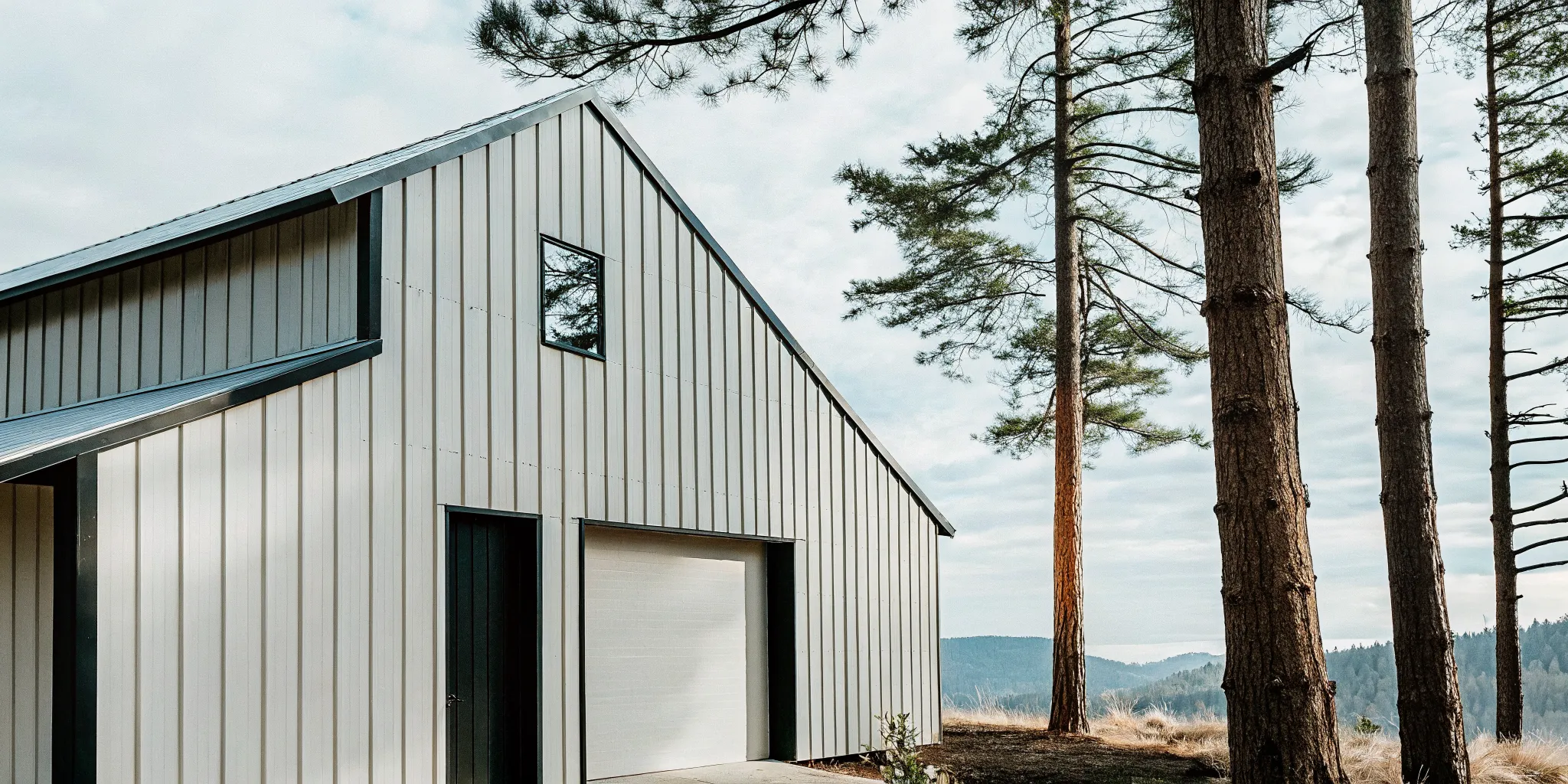
If you are planning to add a new structure to your property in the Pacific Northwest, you have likely run across the term post-frame construction or asked yourself: what is a pole barn? A pole barn is a highly durable and versatile building that utilizes post-frame engineering, where large wooden posts are embedded directly in the ground or anchored to concrete to serve as the primary structural support. This highly efficient building method eliminates the need for continuous poured concrete foundations, making it an exceptionally fast and cost-effective solution for property owners throughout Oregon and Washington.
Use our 3D Building Designer to customize your project today and get an accurate quote for your property.
What Is a Pole Barn?
To fully understand what is a pole barn, it helps to look at its history and structural design. The origin of the modern pole barn dates back to the 1930s during the Great Depression. In response to a tough economy, farmers began repurposing discarded telephone poles to build inexpensive, sturdy barns. This creative approach led to the term “telephone-pole barn,” which eventually evolved into the modern “pole barn” or “pole building” we know today.
According to historical agricultural extension documentation from Cornell University (NRAES-1), early pole buildings proved that embedding vertical supports deep into the ground provided incredible stability against lateral forces like wind without requiring expensive continuous foundation footings. Today, post-frame construction has evolved from those simple agricultural shelters into highly engineered, modern structures that meet stringent local building codes.
In a modern pole barn, highly engineered solid-sawn or laminated wood posts replace old utility poles. These heavy timber posts are spaced farther apart than traditional framing studs, typically 8 to 12 feet on center. They transfer wind, rain, and snow loads directly down to the earth, creating an incredibly strong and resilient structural skeleton.
How Is a Pole Barn Built?
The post-frame building method differs significantly from traditional stick-built construction. Understanding the step-by-step building process highlights why pole barns are so efficient to build and customize. Here is how a high-quality post-frame building is constructed:
- Site Preparation: The building site is cleared, leveled, and prepared. Unlike stick-built homes, no continuous deep foundation trenching is required. Learn more about preparation in our Complete Guide to Post-Frame Construction in Oregon and Washington.
- Post Embedment and Foundation: Holes are augered deep into the ground (typically 4 feet or deeper depending on frost lines and local codes). Concrete footings or pads are placed at the bottom of the holes, and the pressure-treated wooden posts are set on top. Alternatively, posts can be anchored to concrete piers or a concrete slab using specialized metal brackets. This is a crucial step for long-term pole barn durability.
- Girts and Purlins: Horizontal wooden boards called “wall girts” are fastened to the outside of the posts. Similarly, “roof purlins” are installed horizontally across the roof trusses. This interlocking grid of horizontal and vertical wood creates a highly rigid outer frame.
- Truss Installation: Engineered wood trusses are lifted and secured to the top of the vertical posts to support the roof. This design allows for massive clear spans, often up to 100 feet wide, without requiring interior load-bearing walls.
- Siding and Roofing: High-grade metal siding and steel roofing are fastened directly to the girts and purlins. Traditional wood siding, board-and-batten, or composite siding can also be applied for a more custom look.
By relying on large columns spaced far apart, post-frame construction uses fewer materials and requires far less labor than standard stick-built frames, saving time and money during construction.
What Are Pole Barns Used For?
One of the greatest benefits of post-frame structures is their incredible versatility. Because they do not require internal support walls, the interior of a pole barn is a wide-open, highly adaptable blank canvas. Across Oregon and Washington, property owners use pole barns for a massive range of agricultural, residential, commercial, and recreational applications:
- Agricultural Barns and Arenas: Historically, pole barns were built for farming. Today, they remain the gold standard for livestock shelters, hay storage, equipment sheds, and massive indoor equestrian riding arenas.
- Workshops and Garages: Whether you need space for car restoration, woodworking, or a dedicated hobby shop, pole barns offer high ceilings and open spans perfect for heavy machinery, tool storage, and vehicle lifts. See our guide on designing a custom pole barn to plan your ideal workspace.
- Commercial Facilities: From regional retail storefronts and offices to large-scale industrial warehouses and manufacturing facilities, commercial developers select post-frame buildings for their fast construction timelines and customizable layouts.
- Residential Barndominiums: The “barndominium” trend has taken the Pacific Northwest by storm. These highly insulated, beautifully finished residential homes combine a spacious living area with a built-in workshop or garage, all housed under a highly durable post-frame shell.
Explore our custom DIY pole building kits to find the right materials and plans for your project, whether you are building a backyard workshop or a complex agricultural facility.
Pole Barn vs. Pole Building: Is There a Difference?
In the construction industry, you will often hear the terms “pole barn” and “pole building” used interchangeably. While they refer to the exact same underlying post-frame construction method, there is a slight modern distinction in how they are perceived:
| Feature/Term | Pole Barn | Pole Building |
|---|---|---|
| Historical Context | Rooted in agriculture, farming, and simple storage. | Refers to modern, engineered post-frame structures. |
| Primary Aesthetic | Rustic, traditional metal siding, agricultural look. | Highly customizable with wood, steel, or stone facades. |
| Typical Uses | Hay storage, horse arenas, livestock barns, equipment storage. | Commercial storefronts, custom garages, residential barndominiums. |
| Engineering | Can be non-engineered or simple prescriptive designs. | Fully engineered to meet strict commercial and residential building codes. |
When choosing between these options, reviewing a pole barn vs metal building comparison can help you decide which material package and frame type fits your property’s specific goals.
Why Pole Barns Are Popular in Oregon and Washington
Post-frame construction is uniquely suited to the diverse climate and terrain of the Pacific Northwest. Here is why so many property owners in Oregon and Washington choose to build pole barns:
- Weather Resilience: From heavy coastal rains and high wind gusts to significant mountain snow loads, buildings in the PNW must be incredibly tough. Engineered pole buildings distribute environmental forces directly into the deep vertical posts, providing superior wind resistance and structural durability.
- Cost-Effective Construction: Pouring concrete is one of the most expensive parts of any construction project. Because pole barns require simple concrete footings or piers rather than deep, continuous concrete foundations, site prep and foundation costs are drastically reduced.
- Flexible Foundation Options: Many rural PNW properties sit on sloped or uneven ground. Post-frame posts can be adjusted easily to accommodate elevation changes, reducing the amount of site grading and dirt removal needed before construction.
- Local Permitting Knowledge: Permitting in Oregon and Washington can be highly complex. Working with a regional specialist like Locke Buildings ensures your structure is engineered specifically to meet local county wind, snow, and seismic requirements.
At Locke Buildings, we are a family-owned, technology-enabled pole building specialist serving Oregon and Washington since 1981. Our experienced, 50-plus-person team has designed and completed thousands of beautiful, high-quality structures. For clients who want a hands-off experience, we offer full turnkey design-build construction services concentrated from Centralia, Washington to Salem, Oregon. If you prefer to build it yourself, we deliver comprehensive, high-quality DIY pole building kits throughout both states.
Contact Locke Buildings for a free consultation or project quote to discuss your upcoming project and get started today.
Frequently Asked Questions About Pole Barns
What is a pole barn?
A pole barn is a post-frame building that utilizes vertical wooden posts buried in the ground or anchored to concrete to serve as the main support structure. This eliminates the need for expensive continuous concrete footings.
Why do they call it a pole barn?
The term originated in the 1930s during the Great Depression, when cash-strapped farmers began using cheap utility poles and telephone poles as the structural frames for their agricultural barns.
What is the difference between a pole barn and a regular barn?
The main difference is the foundation and framing. A regular barn typically uses stick-frame construction with stud walls resting on a continuous poured concrete foundation. A pole barn uses deep vertical posts set in the ground and horizontal girts, which is faster and more cost-effective.
What are the disadvantages of a pole barn?
While highly versatile, pole barns may not be suitable for multi-story residential structures without advanced structural engineering. Additionally, because the wooden posts are buried, high-quality pressure-treated wood and proper drainage are essential to prevent wood rot over time.
How many years will a pole barn last?
With high-quality pressure-treated timber, proper concrete pad design, and modern steel siding, a professionally constructed pole barn can easily last between 40 to 60 years or more with minimal maintenance.