Buildings Completed
Family-Owned & Operated
5-Star Customer Reviews
Design Your Pole Building — Get a Quote Today
Use our 3D Building Designer to create your custom pole building, then submit your design for a free, detailed quote. No obligation — just a smarter way to start your project.
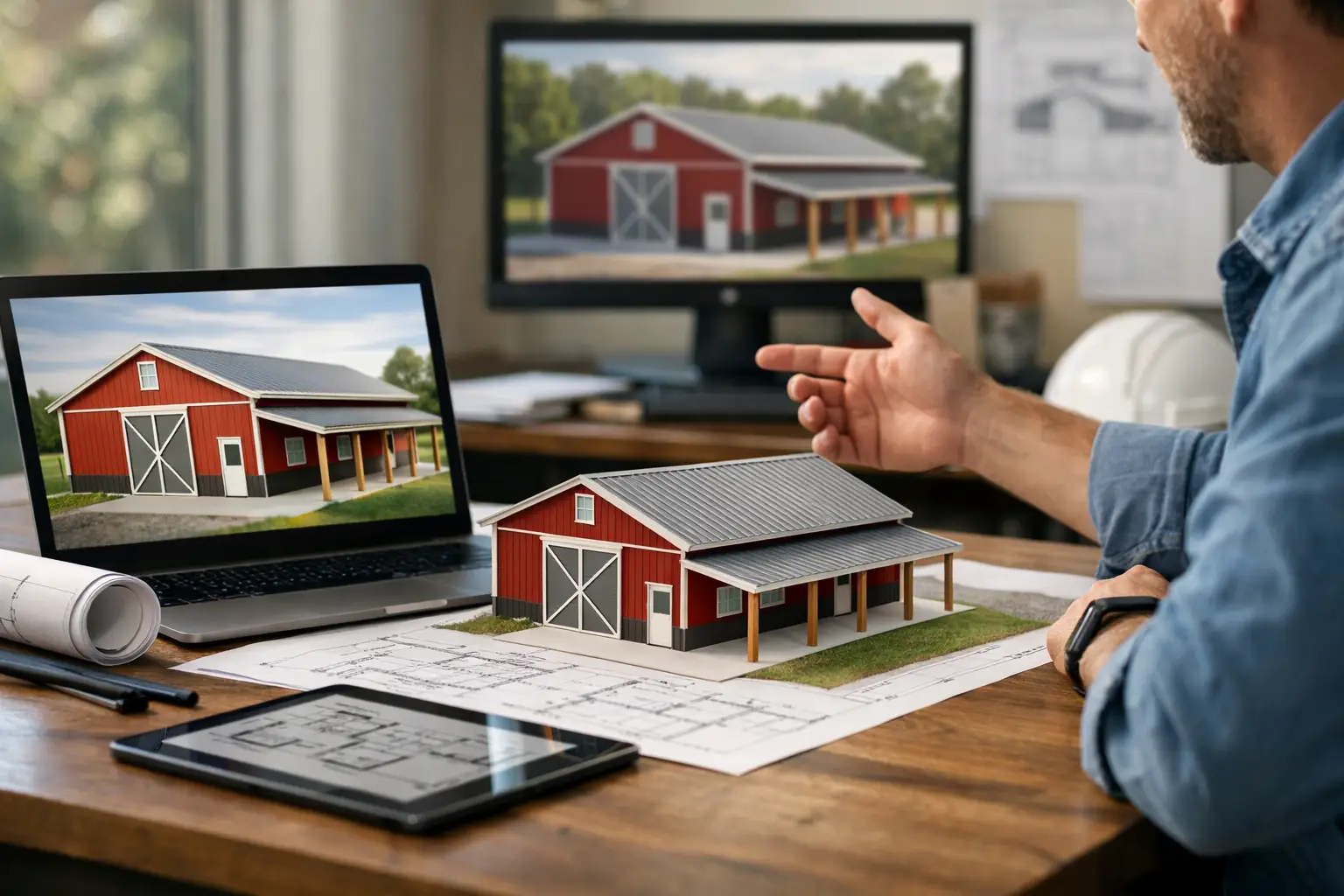
If you have ever priced a pole building based on a rough sketch on paper, you already know where projects start to drift. A door ends up too narrow for equipment. The roof pitch looks different than expected. The building seemed large enough until you tried to picture a tractor, tack room, or shop bay inside it. A 3d pole barn designer helps solve that problem before materials are ordered or construction starts.
For most property owners, the real value is not the graphics. It is decision-making. A design tool lets you test width, length, height, roof style, openings, and basic layout in a way that is easier to understand than a simple dimension list. That matters whether you are planning a farm shop, horse barn, storage building, garage, barndominium shell, or commercial post-frame structure.
What a 3D pole barn designer actually does
A good 3D design tool gives you a working visual model of your building. Instead of trying to imagine a 36×48 shop with two overhead doors and a lean-to, you can see how those pieces fit together. That changes the conversation from guesswork to planning.
In practical terms, the tool helps you sort out the questions that affect budget and function most. How tall do the sidewalls need to be for your RV, tractor, or trailer? Would one large overhead door work better than two smaller ones? Is a gable end entry more useful than a sidewall entry? Does a monitor-style or raised center aisle layout make sense for your use, or would a simpler roofline do the job better?
Those are not cosmetic choices. They affect material takeoff, framing approach, usability, and price.
Why a 3D pole barn designer matters before you request a quote
The biggest pricing problems usually start with incomplete information. If a buyer asks for a quote on a “barn” or a “shop” without nailing down dimensions, door sizes, overhangs, window placement, or intended use, the first number is often just a placeholder. That may be enough for ballpark budgeting, but not for real project planning.
Using a 3d pole barn designer first gives the quoting process better inputs. That typically leads to fewer revisions and a more useful estimate. It also helps separate needs from wants. A customer may start out thinking they need a 40×60 building, then realize that a 36×48 layout with better door placement works just as well. In other cases, the opposite happens. What looked large enough on paper turns out to be too tight once equipment access and storage clearance are considered.
That kind of adjustment is much cheaper on a screen than in the field.
The decisions that matter most in the design stage
A lot of buyers focus first on footprint, and that is understandable. Width and length are the easiest numbers to compare. But the projects that work well over time are usually the ones planned around use, not just square footage.
Size should match movement, not just storage
If the building will house tractors, horse trailers, hay, boats, work trucks, or shop equipment, clear movement paths matter as much as floor area. A building can be technically large enough and still be frustrating to use every day. Turning radius, pull-through access, lift height, and aisle space all need to be considered early.
For equestrian use, that might mean room for stalls, tack storage, wash space, and a center aisle that does not feel cramped. For a workshop, it might mean enough wall height for a vehicle lift or enough depth to park equipment and still maintain a work zone. For commercial use, it may mean planning around delivery access, overhead doors, and interior flow.
Door placement changes the way the building works
Doors are one of the most common redesign items because they are easy to underestimate. The width and height need to fit the biggest thing going in and out, with room for real-world use, not just minimum clearance. Placement matters too. If an overhead door is technically large enough but sits in the wrong wall, maneuvering may become awkward fast.
This is where a 3D view helps. It lets you see whether the building layout supports your traffic pattern or fights it.
Roof style affects both appearance and use
Roof style is partly visual, but not only visual. Gable, monitor, single-slope, and other configurations can change interior clearance, drainage behavior, ventilation options, and cost. The best choice depends on how the building will be used, the site conditions, and how much customization makes sense for the budget.
There is rarely one universal right answer. A basic gable roof may be the smartest fit for many storage and shop buildings. A more specialized layout may be worth it for horse barns, riding spaces, or mixed-use structures. The point of the design stage is to make those trade-offs while there is still flexibility.
What a 3D pole barn designer will not do
It helps to be clear about limits. A 3D tool is useful, but it is not a substitute for experienced project review.
It will not tell you everything about site prep, drainage, engineering requirements, snow load, wind exposure, local code issues, or permit steps. It will not automatically know whether your slab plan, insulation goals, or door package match the climate and use conditions on your property. It also will not replace the judgment that comes from building in Oregon and Washington, where weather, soil, and local requirements can vary a lot from one area to the next.
That is why the design tool works best as part of a guided process. It gets your ideas into a clearer form, then an experienced pole building team can review the details, identify gaps, and help refine the plan.
How to use a 3D pole barn designer well
The best results come from starting with function. Before adjusting colors or trim, define what the building needs to do. Think through the largest vehicle or equipment it must hold, how often it will be accessed, whether you need open storage or enclosed space, and who will build it.
If you are planning a kit project, you may want a design that balances performance with straightforward assembly. If you are hiring a contractor for turnkey construction, your priorities may lean more toward long-term workflow, finish details, and site-specific features. Neither path is wrong. They just lead to different planning decisions.
It also helps to think one step ahead. Many buyers plan around current needs only, then outgrow the building faster than expected. If you know another trailer, more hay storage, additional stalls, or future shop equipment is likely, it makes sense to account for that now when possible.
At Locke Buildings, that practical planning approach is what makes the design and quote process more useful. The point is not to spin a model on a screen. The point is to move toward a building that actually fits the property, the budget, and the work it needs to handle.
Who benefits most from using one
First-time buyers usually get the biggest immediate benefit because it helps them translate a rough idea into a real structure. But experienced builders and contractors use these tools well too, especially when they need to compare layouts quickly or communicate options to partners, customers, or family members involved in the decision.
A rural homeowner planning a garage or hobby shop can use it to sort out dimensions and door setup. A farmer can test whether machinery storage, hay space, and access points make sense together. An equestrian buyer can compare aisle layouts, stall placement, and roof configurations. A business owner can look at practical access and building scale before moving to formal pricing.
Across all of those uses, the main benefit stays the same. Better planning reduces avoidable changes.
From concept to buildable plan
A good building project usually starts with a few simple questions. What is the building for? What needs to fit inside? How should traffic move through it? Who is responsible for construction? Once those answers are clear, a 3D design tool becomes much more than a visual extra. It becomes a way to tighten the scope before money and time start moving.
That is especially valuable with post-frame buildings because customization is one of the biggest advantages of the system. You are not locked into a one-size-fits-all structure. But that flexibility only helps if the choices are made with a clear purpose.
If you are in the early planning stage, use the design process to pressure-test your assumptions. Make the building wider if access is tight. Raise the wall height if overhead clearance is marginal. Move doors if traffic flow looks awkward. Simplify features that do not add function. Add the details that will matter every week once the building is in use.
The right plan should feel practical before it ever reaches the jobsite. That is the real job of a 3d pole barn designer – helping you make smart decisions while they are still easy to change.