If you have ever walked into an uninsulated pole barn on a cold Oregon morning or during a hot stretch in eastern Washington, you already know why a solid pole barn insulation guide matters. The building can look finished from the outside and still be uncomfortable, noisy, damp, and expensive to heat or cool. Insulation is what turns a basic shell into a building that works the way you need it to.
The right approach depends on how you plan to use the building. A horse barn has different priorities than a heated workshop. A storage building used for farm equipment is not the same as a barndominium or commercial shop. Good insulation planning starts with use, then moves to moisture control, ventilation, wall and roof assembly, and budget.
Start this pole barn insulation guide with building use
Insulation is not one-size-fits-all. If you are storing tractors and hay, you may want to limit condensation and moderate temperature swings without fully conditioning the space. If you are building a shop with regular occupancy, you are usually aiming for year-round comfort and lower utility costs. If the structure includes finished living space, the insulation strategy needs to meet a much higher standard.
This is where a lot of projects get off track. Owners ask for the “best” insulation without first defining how the building will be heated, cooled, ventilated, and occupied. The best option for a machine shed may be a poor fit for a garage gym, and the right choice for a livestock building may be wrong for a woodshop where humidity control matters.
Before you choose materials, answer a few practical questions. Will the building be heated full time, part time, or not at all? Will people work inside daily? Are animals producing moisture? Will you be washing equipment indoors? Do you want a finished interior liner, or is an open structural interior acceptable? Those answers drive the insulation system.
Moisture control matters as much as R-value
Most insulation conversations focus on R-value first. That matters, but moisture control is just as important in a post-frame building. In the Pacific Northwest, moisture can come from outside weather, interior humidity, roof condensation, wet equipment, livestock, and concrete slabs.
If warm, moist air reaches a cold metal roof or wall panel, condensation can form. That is when you start seeing dripping, musty air, wet insulation, rust concerns, and interior damage. Once insulation gets wet, performance drops. In some cases, the assembly can trap moisture and make the problem worse.
A good plan looks at the whole system. That includes vapor retarders where appropriate, ventilation paths, closure details, under-slab treatment if the building is conditioned, and proper separation between indoor air and cold metal panels. Skipping those details to save money up front often costs more later.
Common insulation options for pole barns
There is no single insulation product that fits every pole barn. Most projects use one of a few proven approaches, sometimes in combination.
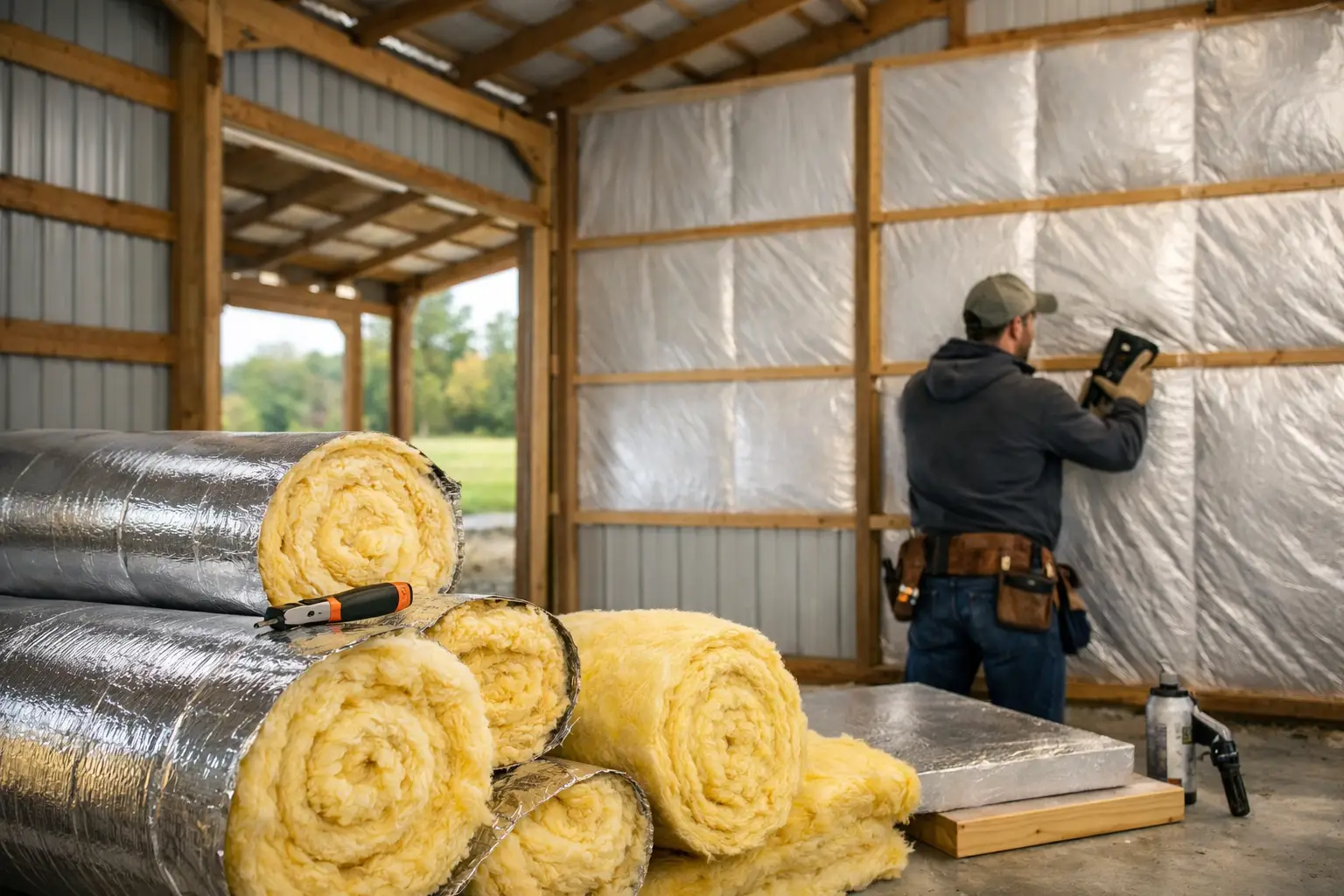
Fiberglass blanket or batt insulation
Fiberglass is common because it is familiar and relatively affordable. In walls and ceilings, it can work well when installed correctly and paired with the right vapor and ventilation details. It is often a reasonable choice for shops, garages, and storage buildings where budget matters.
The trade-off is installation quality. Fiberglass loses effectiveness when it is compressed, left with gaps, or exposed to moisture. In metal buildings, poor detailing around girts, purlins, and roof lines can create thermal breaks and condensation issues. It is not a forgiving system if the assembly is sloppy.
Spray foam insulation
Spray foam gives you insulation plus air sealing in one product, which is a major advantage. Closed-cell foam is especially useful where moisture resistance and added rigidity matter. It can be a strong choice for workshops, conditioned garages, and buildings where controlling air leakage is a top priority.
The downside is cost. Spray foam usually carries a higher upfront price than fiberglass. It can also make future changes more involved, especially if you plan to run wiring or alter interior finishes later. For some owners, that extra cost is justified by performance. For others, it pushes the project beyond budget.
Rigid foam board
Rigid foam is often used in specific parts of the building rather than as the only insulation layer everywhere. It can be effective under slabs, on foundations, or as part of a layered wall or roof system. It helps reduce thermal bridging and can support a tighter building envelope.
Its usefulness depends on the assembly. In some pole barn designs, rigid board is part of a more advanced system rather than the simplest route. It tends to make the most sense when you are targeting a more finished, conditioned, or high-performance building.
Reflective insulation and radiant barriers
These products are sometimes used under metal roofing to help with radiant heat and condensation control. They can play a role, but they are often misunderstood. A reflective product by itself is usually not enough for a heated or cooled shop that needs real thermal performance.
This is where expectations matter. If your goal is basic condensation reduction in a simpler storage building, a reflective layer may help. If your goal is four-season comfort, it is usually only one piece of the system.
Roof insulation is usually where comfort is won or lost
In many pole barns, the roof assembly has the biggest effect on interior comfort. Heat gain and heat loss through the roof can be substantial, especially in large open buildings with metal roofing.
For a conditioned shop or garage, roof insulation should be planned carefully around the framing system and ceiling style. If you have a flat ceiling with attic space above, that opens one set of insulation options. If you want an open interior with exposed trusses or a vaulted appearance, the approach changes.
Ventilation also needs to be considered alongside insulation. Ridge vents, soffit vents, and air channels can all matter depending on the roof design. The exact setup depends on whether the roof assembly is vented or unvented. There is no shortcut here. Roof systems need to be designed, not guessed at.
Wall insulation choices depend on finish level
Wall insulation is often simpler than roof insulation, but finish expectations still matter. If you want a clean interior with liner panels, framed service cavities, and better durability in a shop, the wall assembly should reflect that from the start. If the building is a basic utility structure, the wall system may stay simpler.
This is also where future use should be considered. Many owners start with a storage building and later want a workshop or hobby space. If that might happen, it is smart to think ahead now. It is easier and cheaper to plan for insulation and interior finishes during design than to retrofit the building later.
Slab and perimeter insulation are easy to overlook
If the building will be heated, the floor matters. A cold slab can make a building uncomfortable even when the air temperature seems acceptable. It can also contribute to condensation when warm air meets a cooler floor surface.
Under-slab vapor protection is important, and slab edge insulation may also be worth considering depending on the use. This becomes especially relevant in shops, garages, and any building with finished or frequently occupied space. If you skip the slab details, you may feel that decision every winter.
The best insulation plan depends on your building type
A livestock barn needs moisture management, fresh air, and durability more than residential-style comfort. A riding arena may need to reduce condensation and moderate temperatures without becoming fully conditioned. A workshop often benefits from stronger air sealing and better roof performance because people spend long hours inside.
For barndominiums or mixed-use buildings, insulation planning becomes more complex because one structure may include both conditioned living space and utility areas. Those spaces should not be treated the same. The right answer is often a split strategy rather than one blanket solution across the entire building.
Budget trade-offs are real
Every insulation decision is a balance between upfront cost, operating cost, and building performance. It rarely makes sense to overbuild insulation in a structure that will not be heated or occupied much. It also rarely makes sense to under-insulate a shop you plan to use year-round.
The practical question is not just, “What costs less today?” It is, “What fits the way this building will actually be used over the next 10 to 20 years?” That is the better way to evaluate insulation options.
For many owners, the smartest move is to spend where performance matters most – often the roof assembly, air sealing, and moisture control – while avoiding upgrades that do not change day-to-day use enough to justify the expense.
Plan insulation early, not after the shell is up
Insulation works best when it is part of the design process, not an afterthought. Roof style, framing layout, ceiling choice, doors, windows, ventilation, and intended occupancy all affect the right insulation strategy. Once the shell is built, some of the best options become harder or more expensive to execute.
That is why insulation should be discussed when you are defining dimensions, use, and finish level. An experienced post-frame builder can help you sort out whether you need basic condensation control, a moderately insulated work space, or a fully conditioned building envelope. For customers in Oregon and Washington, that kind of planning is where a lot of long-term value gets built in.
A pole barn does not need the most expensive insulation package to perform well. It needs the right system for the way you will use it, built with the details that keep moisture out and comfort in. Start there, and the building will make more sense from day one.