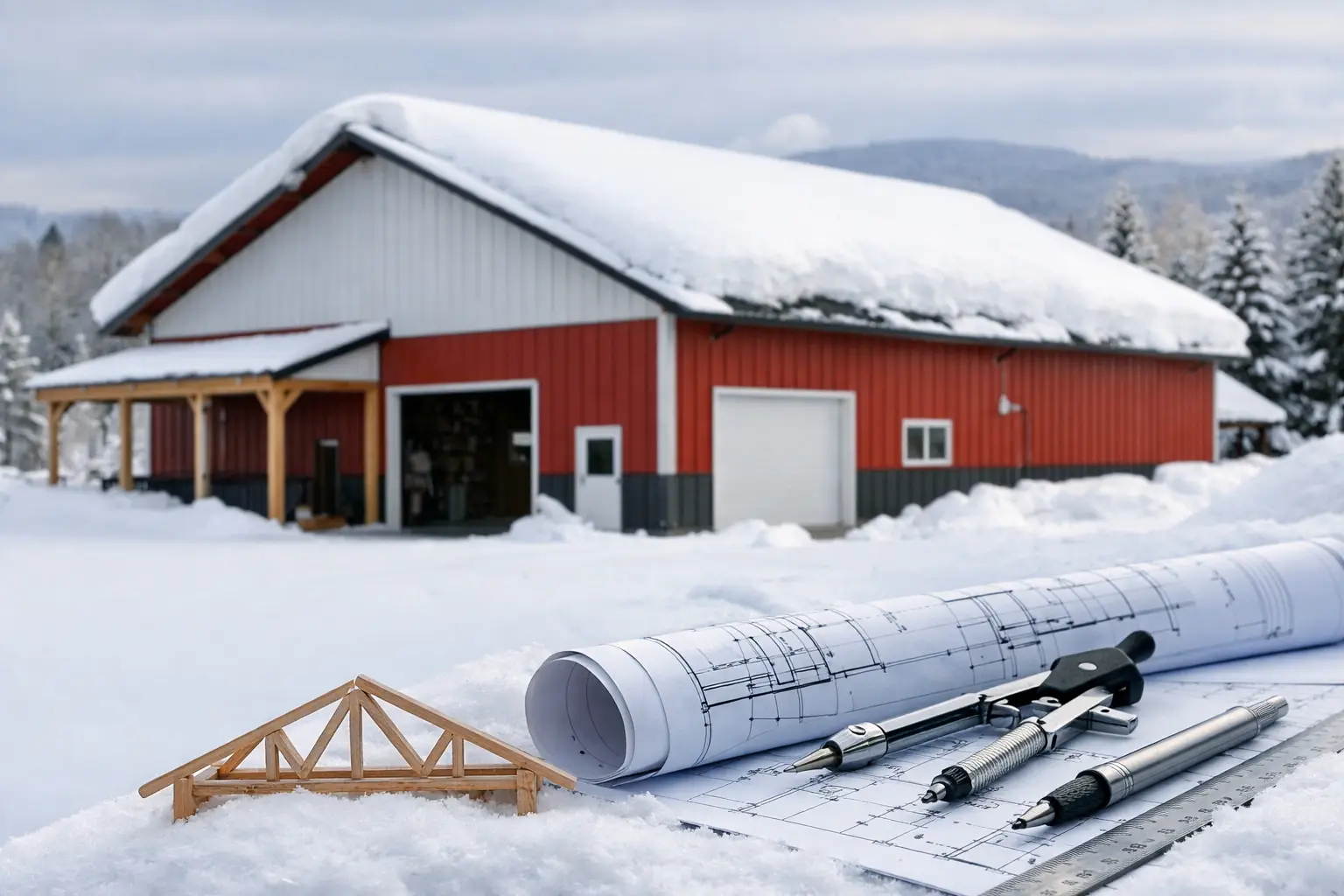
A pole barn that looks right on paper can still be wrong for the property if snow load planning is off. In Oregon and Washington, that matters more than many buyers expect. Two buildings with the same footprint can need very different structural designs based on elevation, local exposure, roof shape, and how the county interprets loading requirements.
That is why pole barn snow load planning should happen early, before you settle on rooflines, overhangs, door placement, or interior clear spans. Snow load is not just an engineering box to check at permit time. It affects how the whole building comes together, from material sizing to long-term performance.
What pole barn snow load planning actually covers
When customers hear snow load, they often think only about how much snow might sit on the roof after a storm. That is part of it, but the real planning process is broader. The building has to be designed for the snow load required at the site, and that design then influences trusses, purlins, posts, connections, footing design, and sometimes the practical layout of the structure.
In plain terms, snow load planning answers a few critical questions. How much weight could the roof reasonably be expected to carry at that location? How does the roof shape change the way snow builds up or slides? Where might drifting occur? And does the intended use of the building create any layout choices that push the structure toward longer spans or more open interior space?
A hay barn, machine shed, horse barn, riding arena, garage, and shop can all start from the same post-frame building system, but they do not all carry snow in the same way. A wide-open shop with large overhead doors and minimal interior posts may need a different structural approach than a compartmentalized agricultural building with shorter spans.
Why location changes the design
One of the biggest mistakes in pole barn snow load planning is assuming there is a standard answer for an entire state. There is not. Oregon and Washington include coastal areas, valleys, foothills, mountain-adjacent properties, and inland zones where snow patterns change significantly.
Elevation plays a major role, but it is not the only factor. Local topography, exposure to wind, and jurisdictional requirements can all affect what the building must be designed to handle. A property owner may look at neighboring structures and assume the same design will work, but those buildings may have been built under older codes, for a different use, or with different engineering assumptions.
This is where local experience matters. A building supplier or contractor working regularly in the region will usually recognize the difference between a site that looks straightforward and one that needs a closer structural review. That can save time before you commit to a design that later has to be revised.
Roof pitch, building width, and snow behavior
Roof pitch gets a lot of attention, and for good reason. Steeper roofs can help shed snow more readily in some conditions, but that does not mean a steep roof automatically solves every snow load issue. Wet snow, ice buildup, temperature swings, and roof surface conditions can all change how snow behaves.
Building width matters too. A wider clear span often means larger structural demands, especially when you want an open interior for equipment storage, livestock movement, or shop use. That does not mean wide buildings are a problem. It means they need to be planned correctly from the start.
There is also a trade-off between appearance and performance. A low-slope roof may fit the look a buyer wants and can work well for certain uses, but in snow country it may require stronger framing to carry the expected load. A taller pitch may help in some scenarios while affecting material quantities, wall height, and overall project cost. Good planning is about balancing those factors instead of chasing a one-size-fits-all rule.
Clear spans and large openings add complexity
Many buyers want a post-frame building because it gives them usable open space. That is one of the system’s biggest strengths. But if you combine heavy snow requirements with wide clear spans, tall sidewalls, and large overhead or sliding door openings, the structure has to do more work.
For example, a workshop with a large RV door, open interior bay, and storage loft is asking the building to perform in several ways at once. Each of those decisions can be workable, but they should be considered together. A large opening can reduce wall bracing options in one area. A loft adds another load consideration. A wide span changes what the roof system must carry. Snow load planning ties those decisions together so the design stays practical.
This is why it helps to define building use clearly at the quote stage. If the real goal is equipment storage today and enclosed shop space later, that should be part of the design conversation. It is much easier to account for future needs up front than to discover later that an upgrade creates structural complications.
Pole barn snow load planning for different building types
Not every building needs the same approach, even on the same property. An animal barn may have partitions and shorter bay spacing that naturally support the design differently than a commercial warehouse or arena. A garage with attic storage raises different questions than an open-sided loafing shed.
Riding arenas deserve special attention because they often combine wide dimensions with the need for open interior space. The same goes for commercial and agricultural buildings that require uninterrupted movement for vehicles, trailers, or equipment. In these cases, snow load planning is closely tied to how the building will function day to day.
Residential-style post-frame buildings, including barndominiums and large garages, can also bring more complexity than buyers first expect. Roof extensions, porches, dormers, and attached spaces can create areas where snow drifts or accumulates differently. Those features can absolutely be incorporated, but they need to be part of the engineering discussion, not treated as cosmetic add-ons.
What to have ready before you request a quote
The fastest way to get useful guidance is to provide the job details that affect structure, not just the rough size. Start with the building location and as specific a site description as you can provide. If the property is at higher elevation, near exposed hills, or in an area known for heavier snow, say so early.
You should also define the intended use as clearly as possible. Is this for livestock, hay, equipment, vehicles, a shop, commercial storage, or mixed use? Will the building need full clear span space? Are you planning overhead doors, sliding doors, lean-tos, insulation, or interior framed areas? Those decisions do not just affect price. They affect how the structure is designed.
If you already have a sketch, site plan, or reference layout, provide it. Even a basic concept can help identify issues before they become change orders. For customers comparing a building kit versus a full-service build, accurate early planning is valuable either way because it sets the project up correctly before materials are ordered or crews are scheduled.
Cost matters, but underbuilding costs more
Most buyers are trying to hit a budget, and that is reasonable. The problem starts when snow load is treated like an optional upgrade instead of a core design requirement. A lower quote is not necessarily the better quote if it leaves out the level of engineering your site demands.
The better question is whether the building is being designed for the real conditions it will face. If the answer is yes, then you can make smart choices about dimensions, roof style, door sizes, and finish options to manage cost without compromising structural performance.
That practical approach is especially important for owners who want to self-build or hire their own contractor. A complete, site-appropriate package helps reduce confusion in the field and lowers the risk of expensive corrections after the project is underway.
Start with the site, not the sketch
Good-looking plans are easy to change. Structural assumptions are harder to fix once a project is moving. That is why experienced builders start pole barn snow load planning with the site conditions and the intended use, then shape the building around those realities.
If you are planning a post-frame building in Oregon or Washington, the smartest next step is to define where it will sit, what it needs to do, and how open or customized it needs to be. From there, the right design becomes much clearer, and the building has a far better chance of performing the way it should for years to come.
A solid building starts long before the first post goes in the ground. The more clearly you plan for snow, the more confidence you can have in every other decision that follows.