A post frame insulation guide matters most when the building looks simple on paper but has to work hard in real life. A hay barn, shop, garage, arena, or barndominium can all be built with the same structural approach, but the insulation plan should change based on use, climate, and how finished the space needs to be.
That is where many projects go sideways. Owners often choose insulation after the shell is already designed, when in reality the insulation strategy affects wall girts, roof details, ventilation, interior liner choices, condensation control, and long-term operating cost. If you want a building that stays comfortable, protects contents, and performs well in Oregon or Washington, insulation needs to be part of the plan from the beginning.
What insulation has to do in a post-frame building
Insulation is not just about keeping heat in. In post-frame construction, it also helps manage condensation, reduce temperature swings, improve sound control, and make the building easier to heat or cool. For some uses, that is enough. For others, especially conditioned shops, commercial spaces, and living areas, insulation also becomes part of the air sealing and moisture management strategy.
A cold storage building and a heated workshop should not be insulated the same way. Neither should a horse barn and a barndominium. The right answer depends on whether the space will be occupied regularly, whether you are adding HVAC, and whether you need a finished interior surface.
This is why there is no single best insulation package. There is only the best fit for the building you are actually using.
Start with the building use, not the insulation product
The first question is simple: what will happen inside the building? If the structure is mainly protecting equipment, feed, or vehicles from weather, your priorities may be condensation control and moderate temperature buffering. If people will work inside every day, comfort and energy efficiency matter more. If animals are involved, ventilation often becomes just as important as R-value.
A basic storage building may do fine with a simpler system that controls roof condensation and limits heat gain. A workshop usually benefits from insulated walls and roof, tighter air sealing, and a more complete interior finish. A commercial building may need to meet code requirements for continuous use, occupancy, and mechanical conditioning. A barndominium has another level of complexity because you are dealing with residential comfort expectations and more demanding wall and roof assemblies.
When owners skip this step, they tend to overspend in the wrong places or underbuild the areas that matter most.
Post frame insulation guide: the main options
In post-frame buildings, the most common insulation approaches are fiberglass, spray foam, rigid foam, or a combination of those materials. Each has a place.
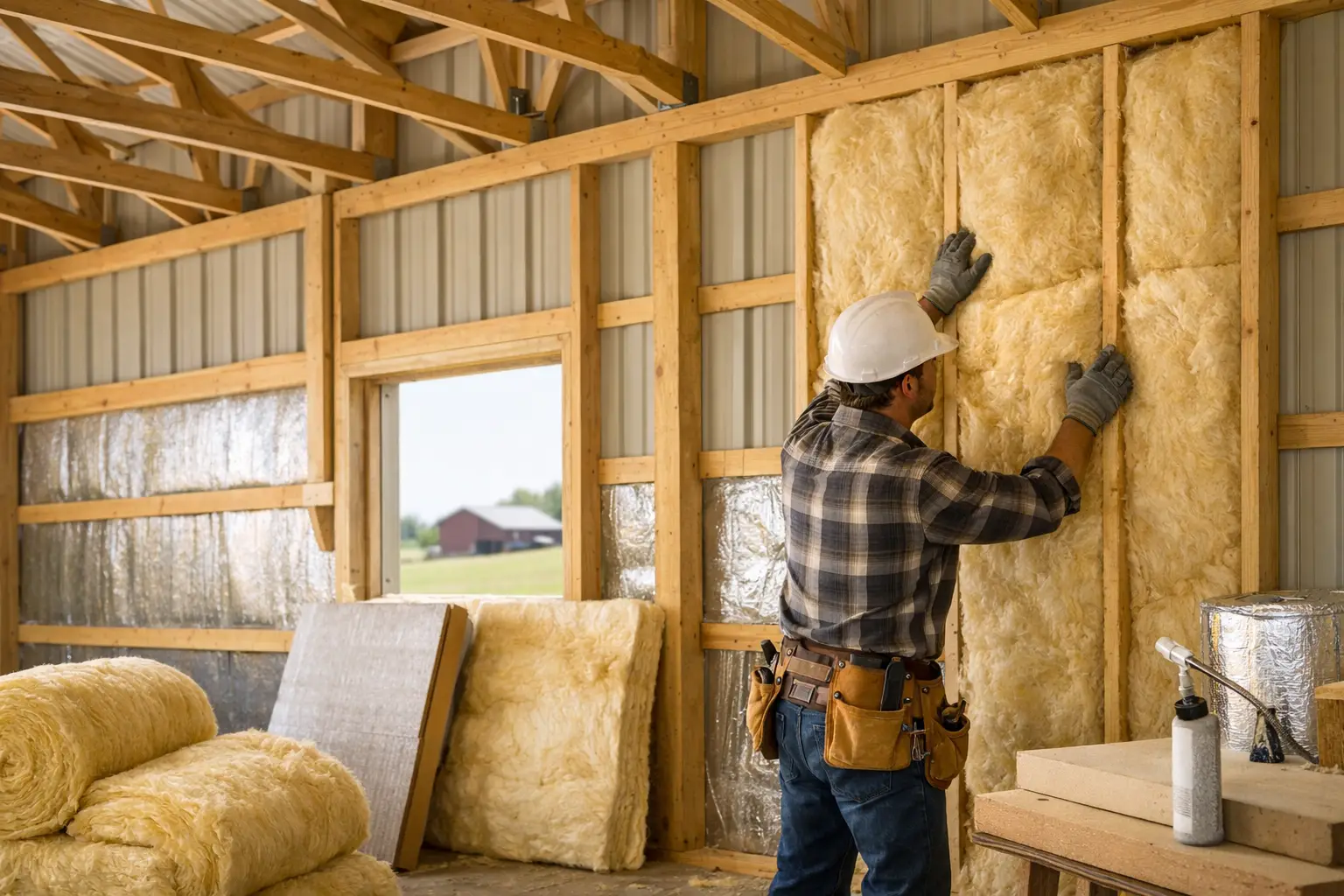
Fiberglass is often the most budget-friendly route for larger wall and ceiling areas. It can work well when the building is designed to support it properly and when air sealing and vapor control are handled correctly. It is common in finished shops, garages, and commercial spaces, especially when paired with interior liners or framed cavities.
Spray foam costs more up front, but it can provide both insulation and air sealing in one application. Closed-cell foam is especially useful where moisture control and higher R-value per inch matter. It is often a strong option for buildings that need to manage condensation, irregular surfaces, or limited cavity depth. Still, cost can be a deciding factor, and not every project needs that level of system.
Rigid foam is usually part of a layered approach rather than the whole answer. It can help reduce thermal bridging and improve overall assembly performance, especially in roofs or finished wall systems. But it needs to be coordinated with the rest of the structure and interior finish.
Reflective and radiant barrier products also show up in post-frame projects, but they are often misunderstood. They can help in certain roof assemblies and hot-weather situations, but they are not a substitute for true insulation in a conditioned building.
Roof insulation is where many problems begin
If there is one area to get right early, it is the roof. In the Pacific Northwest, roof condensation can be a real issue, especially in buildings with metal roofing and fluctuating indoor humidity. A shop with vehicles coming in wet, a barn with animals, or a garage with occasional heat can all create moisture conditions that lead to dripping, corrosion, or mold if the roof assembly is not planned well.
Some buildings need a simple condensation control layer under the roof steel. Others need a full insulated roof system with proper ventilation or a sealed assembly, depending on how the space will be used. The right choice depends on whether the building is unheated, intermittently heated, or fully conditioned.
A common mistake is assuming insulation alone solves condensation. It does not. You also need to think about air movement, indoor moisture sources, and whether the assembly is designed to dry properly. Roof systems perform best when the structure, underlayment, insulation, and ventilation strategy are all working together.
Wall insulation depends on framing and finish plans
Post-frame wall systems are flexible, but that flexibility means wall insulation needs to be coordinated with the frame layout. If you want a clean finished interior, the wall design should reflect that from the start. Girt placement, cavity depth, and interior liner decisions all affect what insulation methods make sense.
For a utility building, a simpler approach may be enough. For a fully finished shop or office area, you may want a deeper assembly with better air sealing and a more complete thermal break. If you are planning plumbing, electrical runs, or interior partitions, those details matter too.
This is especially true in mixed-use buildings. Many owners want a shop area on one side and conditioned office or living space on the other. That can work well, but the insulation plan should follow those use zones rather than treat the entire shell the same way.
Don’t overlook slab edge and doors
People often focus on roof and walls and forget the slab and openings. If you are heating the building, slab insulation can make a noticeable difference in comfort and operating cost, particularly in shops and occupied spaces. A cold floor can make a building feel underinsulated even when the walls and roof are decent.
Overhead doors, sliding doors, and entry doors also matter more than many buyers expect. A well-insulated wall does not do much if large doors leak air or have poor thermal performance. In buildings with frequent door use, this becomes a trade-off between convenience and efficiency. Sometimes the right answer is not just a better door, but a layout adjustment that reduces how often the largest openings are used.
Climate and code are part of the decision
Oregon and Washington include a wide range of weather conditions. Coastal moisture, valley fog, western Washington rain, and colder inland temperatures can all change what a good insulation package looks like. A solution that works for a machine shed in one area may be the wrong fit for a conditioned workshop in another.
Code requirements can also influence the design, especially for occupied commercial buildings, barndominiums, and spaces with mechanical systems. Even when code is not pushing the decision, energy performance and long-term comfort often should. It usually costs less to build the right assembly up front than to retrofit a building after the first winter.
Budget trade-offs are real
A good post frame insulation guide should say this plainly: better insulation is not always better value if it does not match the use of the building. You do not need to build every storage barn like a house. At the same time, underinsulating a year-round shop can cost more over time in energy use, comfort issues, and condensation problems.
The smart approach is to spend where performance matters. That may mean putting more budget into the roof assembly, choosing upgraded doors for a conditioned space, or using a hybrid insulation system instead of the cheapest material across the whole building. It depends on the project.
This is also where early planning pays off. Once the building is erected, your options narrow and retrofit costs rise. Insulation should be part of quoting and design, not an afterthought.
How to choose the right insulation plan
Start by defining whether the building will be unconditioned, occasionally heated, or fully conditioned. Then look at interior finish expectations, moisture sources, and whether people, animals, vehicles, or temperature-sensitive contents will be inside. After that, evaluate roof, wall, door, and slab assemblies together instead of one at a time.
If you are pricing a kit or working with a contractor, be specific. Share how the building will be used, whether you want liner panels or a finished interior, what type of heating or cooling you expect, and whether any part of the building will become office or living space later. Those details change the insulation recommendation.
At Locke Buildings, that is the kind of information that helps turn a rough idea into a building package that performs the way you expect.
A well-insulated post-frame building is not the one with the most material stuffed into it. It is the one designed around how you actually plan to use it, season after season.